
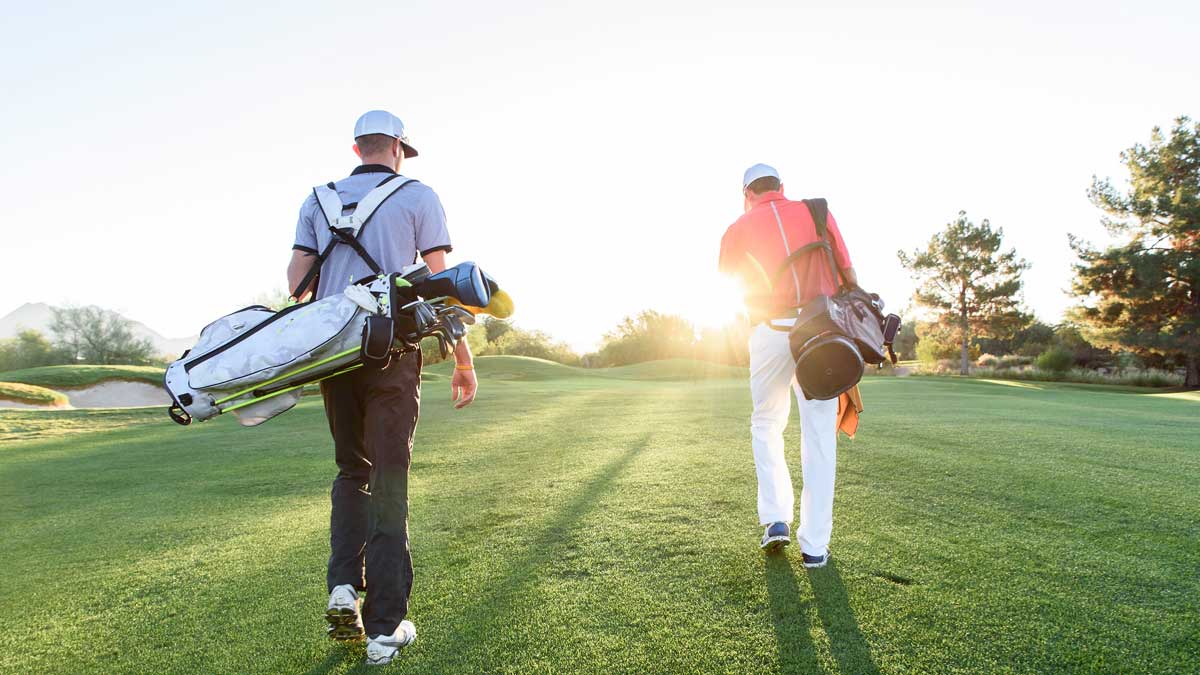
By now, most of us have learned a lot about getting back on the golf course safely. But thereâs no such thing as being too prepared. To clear up lingering questions and potential misconceptions, GOLF.com sought the insights of Dr. William Schaffner, medical director of the National Foundation for Infectious Diseases. Here are 5 takeaways from what he shared.
Pre- and post-round might be more important than the round itself
When youâre out on the course, with lots of room to roam, social distancing is comparatively easy. But other spots before and after can be problematic, including the check-in counter and the parking lot. Dr. Schaffner likens the latter to a congested trailhead: a gateway to low-risk recreation that becomes a hazard as people drop their guard and congregate. âWatch those places where you fall into patterns of congeniality,â Dr. Schaffner says, and start doing things âthe old way as opposed to the new way.â The biggest red flag belongs outside the 19th hole, which most courses have wisely closed. If it happens to be open, Dr. Schaffner says, “Walk right by it. Thatâs the place on the course the virus likes the best.â
The when, where and why of wearing a mask
In some circles, decisions around masks have become fraught with meaning, regarded as a symbol of personal expression rather than a matter of public health. If thatâs how you see it, itâs time to build a bridge and get over yourself, because this isn’t about you alone. At many courses, youâll be asked to wear a mask in and around the clubhouse, and in any other places where you might come into close contact with course employees or fellow golfers. Itâs a simple measure and a smart one, Dr. Schaffner says. On the golf course, he notes, wearing a mask is less crucial â odds are you don’t need one, Dr. Schaffner says â since the vast majority of viral transmissions come through close and prolonged interpersonal contact, and the course gives you room to keep to yourself. Then again, a mask is never going to hurt.
Everyday cloth masks are better at stopping you from spreading the virus than they are at shielding you from it. But it works both ways, so any time social distancing becomes tricky, be considerate of others and slip on a mask. âIf you wear yours, youâre protecting me, and if I wear mine, Iâm protecting you,â Dr. Schaffner says. âWeâre all in this together.â
The truth about lost balls and broken tees
How long can the virus survive on different surfaces? The question has been studied, Dr. Schaffner says, âbut not carefully enough.â Courses have done their best to eliminate touch points, like drinking stations and ball-washers. But here’s another question: Is it safe to pick up lost balls and broken tees? Dr. Schaffner says itâs probably not a problem. But as a precaution, itâs worth packing sanitizing wipes in your bag. Theyâre small, lightweight and efficient virus-killers. Wipe the ball or broken tee with one, Dr. Schaffner says. âAnd youâll be fine.â
Can you borrow your buddyâs lob wedge?
When the PGA Tour resumes action next month, donât be surprised to see players pulling clubs from their bags themselves, rather than relying on a hand-off from their caddie. We know, anyway, that player-caddie interactions wonât be quite the same. But how should the rest of us go about our business? Is it okay, for instance, to toss your partnerâs ball to him when you concede a putt? Or to borrow a club, say, if you left yours on the far side of the fairway in the cart? The answers lie in basic hygiene, Dr. Schaffner says. If you and your partner have both sanitized your hands, and the equipment has been wiped down, too, you can each touch the same ball or club without running any serious risk. And so long as you arenât touching other objects in between, âyou donât have to sanitize your hands on every hole.â
Good on golf so far
Dr. Schaffner is not an avid golfer, but he understands the basics of the game and approves of what heâs seen from the industry thus far. The social distancing requirements. The elevated cups. The food-and-beverage precautions. The stripped-down touch points on the course. Golf isnât life, but nowadays, it pays to bring the rhythms of our lives onto the golf course. âPeople are being thoughtful about translating (health and safety measures) to their own activities,â Dr. Schaffner says. âKeep the general recommendations in mind, and remind yourself of them as youâre going along.â